Bloom's Taxonomy
Bloom's
Taxonomy was created in 1956 under the leadership of educational psychologist
Dr Benjamin Bloom in order to promote higher forms of thinking in education,
such as analyzing and evaluating concepts, processes, procedures,
and principles, rather than just remembering
facts (rote learning). It is most often used when designing educational,
training, and learning processes.
There are six cognitive domains:
1) Creating- Builds a structure or pattern from diverse elements. Put parts together to form a whole, with emphasis on creating a new meaning or structure.
2) Evaluating- Make judgments about the value of ideas or materials.
3) Analyzing- Separates material or concepts into component parts so that its organizational structure may be understood.
4) Applying- Use a concept in a new situation or unprompted use of an abstraction. Applies what was learned in the classroom into novel situations in the work place.
5) Understanding- Comprehending the meaning, translation, interpolation, and interpretation of instructions and problems.
6) Remembering- Recall or retrieve previous learned information.
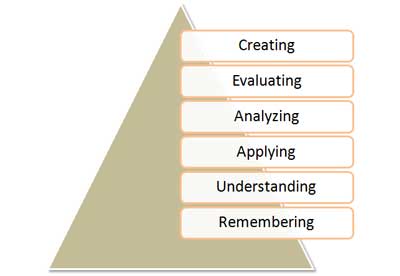
The categories can be thought of as degrees of difficulties. That is, the first ones must normally be mastered before the next one can take place.
Objective example using Bloom's Taxonomy:
Students will be able to construct a two paragraphed letter to a pen pal using Microsoft Office Word document.
THANK YOU FOR VIEWING !

No comments:
Post a Comment